A national cultural symbol in one of the largest displays to date
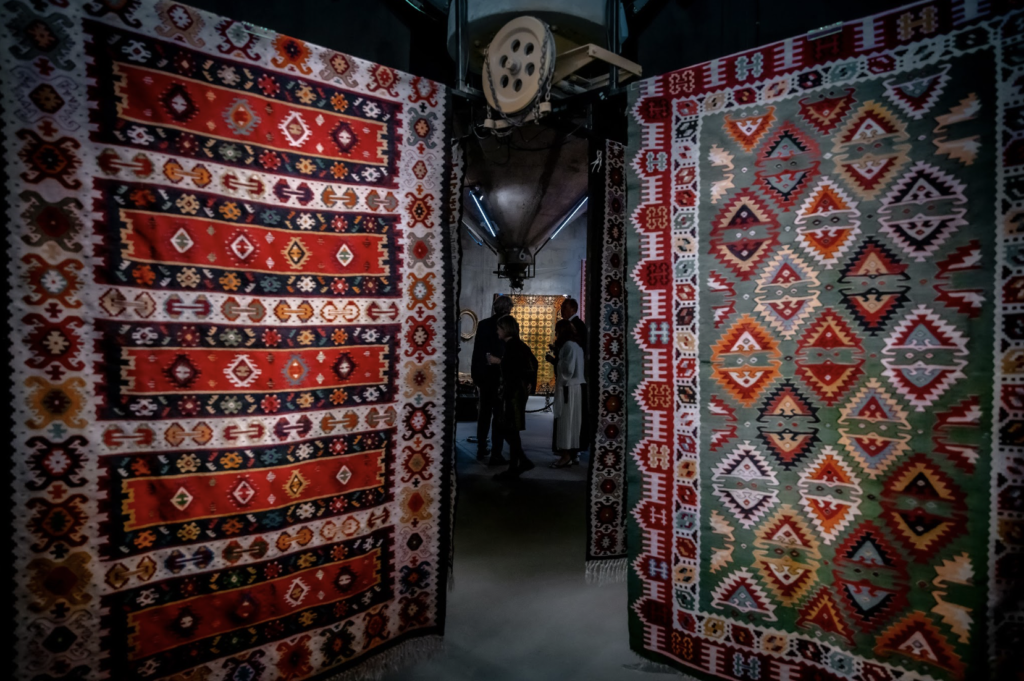
After the exhibition “Reality Through the Eyes of Big Data,” produced as part of the May Month of Mathematics festival—which once again drew tens of thousands of visitors to Belgrade’s Silosi this year—the Silosi venue hosted another major exhibition, this time dedicated to the world-unique Pirot kilim. Produced by the Gaia pokret and titled “The Magic of the Pirot Kilim,” the exhibition was ceremonially opened on June 16 at the Re-kreativni centar Silosi Beograd and was one of the largest exhibitions ever devoted to this symbol of Serbia’s intangible cultural heritage.

The exhibition featured more than 60 large-format Pirot kilims from the Nikolić family collection, along with numerous smaller rugs, šustikle, and pieces of furniture. The exhibition’s co-authors were professors at the Faculty of Applied Arts, Dr. Leonora Vekić and Dr. Zlatko Cvetković, and visitors had the opportunity—through large informational panels prepared in collaboration with graphic design students—to learn more about the history of kilim-making in Serbia and around the world in a contemporary and accessible way.
The exhibition was accompanied by a monograph cataloguing one hundred kilims from the Nikolić family collection, as well as the video work “Kaleidoskop” by academic painter and art historian Dr. Milica Živadinović, and a short documentary film directed by Maja Uzelac. As part of the exhibition, the play “Darovni ćilim Cvete Agnine,” based on a text by Momčilo Antić from Pirot, was also performed, interpreted by actresses Angelina Lukić and Sara Jovanović, in the dialect of southern Serbia, directed by Jug Đorđević, a recipient of the Sterija Award.

During the exhibition, tapestry-making workshops featuring Pirot patterns were organized, along with children’s workshops for drawing Pirot ornaments, as well as a promotion of Milica Živadinović’s book “Ornamenti Srbije.”


The Pirot kilim was recognized as early as the 1892 World’s Fair in Paris as a phenomenon, because it has the same front and back—making it unique in the world. Until 1940, it was regularly presented at world exhibitions as a national symbol of Serbia, and in 1922 it served as the leading decoration at the wedding of King Aleksandar and Queen Marija Karađorđević. Pirot kilims were also given as gifts to the British Queen Elizabeth, as well as to numerous statesmen and celebrities, and many of those examples today are of immeasurable value. Since 2012, Pirot kilim-making has been entered into the National List of Intangible Cultural Heritage of the Republic of Serbia under UNESCO protection, with 96 documented ornaments and 122 patterns, each of which carries a specific folk belief.

The exhibition was also a tribute to Pirot, one of the oldest cities in the Balkans, whose rich tradition and crafts were further presented at the “Bazar pirotskih čarolija,” held on June 23 at Silosi, where visitors could also get to know local delicacies such as peglana kobasica and kačkavalj. The exhibition “The Magic of the Pirot Kilim” was open to visitors until July 2.

A new hub of Belgrade’s social life
During this period, Silosi once again confirmed themselves as a new hub of Belgrade’s social life. As a project of the non-profit organization Gaia pokret, whose activities are based on education, art, sport, and environmental protection, Silosi have so far hosted numerous local artists, students of art faculties, as well as events such as Bitef, EXIT, and Belgrade Fashion Week.

Within the complex, the Honey Garden with an apiary was also developed, from which the multiple award-winning honey brand “Mad Med” emerged, while throughout the year Silosi hosted exhibitions, food and drink festivals, performances, educational panels, craft workshops, yoga classes, bazaars of local products, and many other cultural and social events.