At Silosi Beograd, a mural by Polish artist Nespoon was created—one of the most recognizable contemporary artists whose works connect traditional motifs with a modern urban context. The mural was made on the raw concrete of the silos and represents a lace-like ornament inspired by historical textile heritage.

The lace motif is based on a pattern from the early 19th century, which the artist discovered during a visit to the Ethnographic Museum in Belgrade. A former clothing detail, tied to the everyday life and identity of women, was transferred into a monumental format and placed in the industrial landscape of Silosi, creating a powerful contrast between the delicate ornament and the massive architecture.
Work on the mural posed a special challenge due to the height of the surface and working directly on unfinished concrete, but it was precisely this immediacy that became a key part of the process and the final expression. The mural was created to mark Europe Day in Serbia and is part of the broader vision of Silosi as the future largest urban gallery of silo murals.

The process of creating the mural was also marked by close collaboration and joint work between the artist and her husband, Marcin Rutkiewicz, whose support and presence provided a space of safety, focus, and freedom in creation. From that process, in addition to the artwork, a lasting bond with Silosi emerged—based on trust, togetherness, and mutual respect.
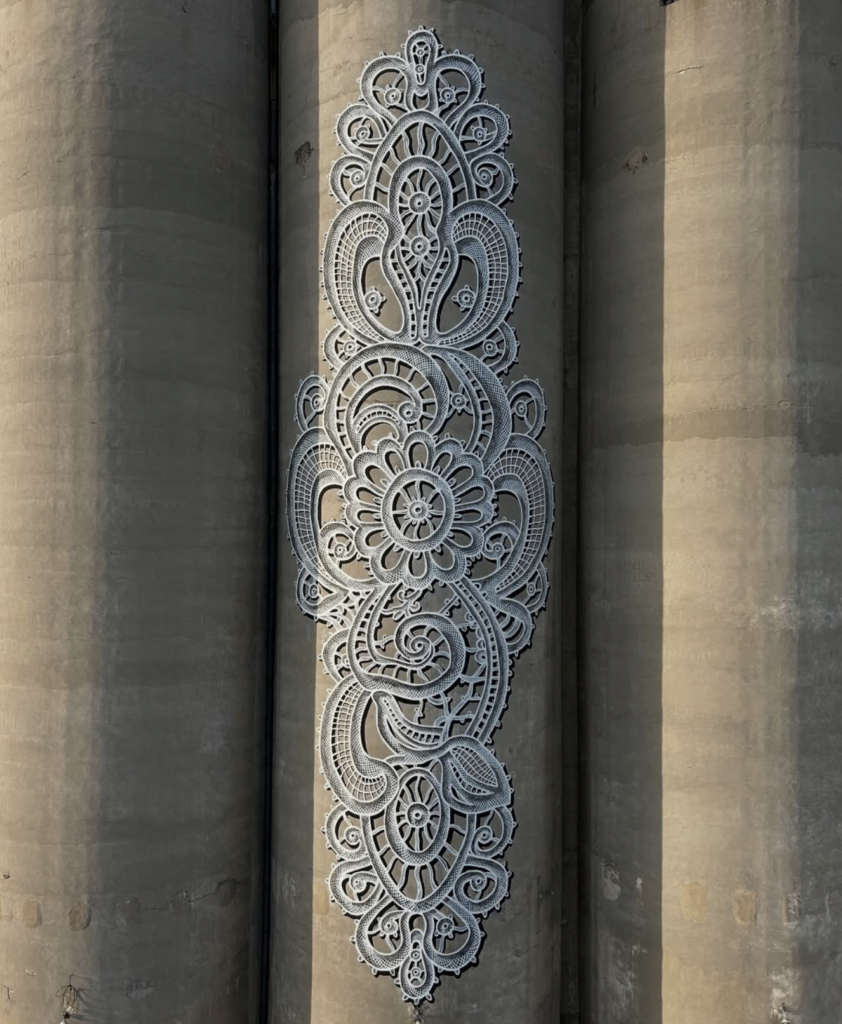
Nespoon’s mural today remains a permanent part of Silosi Beograd—a quiet, precise, and powerful intervention that brings together heritage, contemporary art, and industrial space.